
Compare James City County Property Values
Every James City County property value needs a source and a label. The county's Property Information System blends assessment data with GIS mapping, and a result can show sales price, transfer date, assessment history, land and building descriptions, and source of title. The county overview does not confirm a separate market-value field. Trust the label the county gives each figure. Reading every number on a parcel card as a market estimate is a mistake, since an assessment figure and a recorded sale price answer different questions about the same parcel.
| Value Type | What It Means | Where to Check |
|---|---|---|
| Assessed value | County value used in the assessment and tax process | Real Estate Assessments and Land Book |
| Market value | A sale-oriented opinion; a distinct live field was not confirmed | Use a licensed appraiser for an appraisal |
| Last sale price | Reported price tied to a recorded transfer | Property Information System and deed |
| Assessment history | Prior county assessment information | Property Information System |
Assessment happens on a two-year cycle in James City County. The county publishes no separate ratio or level of assessment on its overview pages. A sale price captures one transaction on one date. An assessment is the county's value for tax purposes. Keep the recorded deed and the assessment result apart as evidence. Their purposes and dates differ.
James City County Biennial Valuation
Real Estate Assessments produces a new valuation for every parcel in James City County every two years. That work feeds the annual Land Book and the public Property Information System. A parcel result can carry assessment history and source of title. It can also carry sales prices, transfer dates, legal description, and land or building descriptions. Those fields show how the county record evolved over time. The public overview gives no standard roll-refresh interval after a closing.
Before weighing a new number against an old one, check the assessment year and the parcel description first. A new structure, a split lot, or a redrawn map can shift the record's context. Any James City County property value belongs to the parcel and assessment period that produced it.
For a same-parcel comparison, note the land and building descriptions and the assessment history. Note any transfer date the county displays too. Then ask whether the lot or its improvements changed between the two assessment periods. A parcel split or combination can make totals look like a value jump. The reason is that the land compared is no longer identical. The county publishes no set closing-to-roll refresh schedule. So identify the record date before concluding anything about a recent sale.
Comparing several nearby parcels takes more than a neighborhood label. Line up locality, parcel area, assessment year, and land and improvement descriptions before you glance at totals. Homes in one subdivision can differ in lot size, recorded easements, structures, and parcel history. County sales-price history can frame a transfer. But a recorded transaction is tied to its date and legal description. It is not a forecast of a current offer.
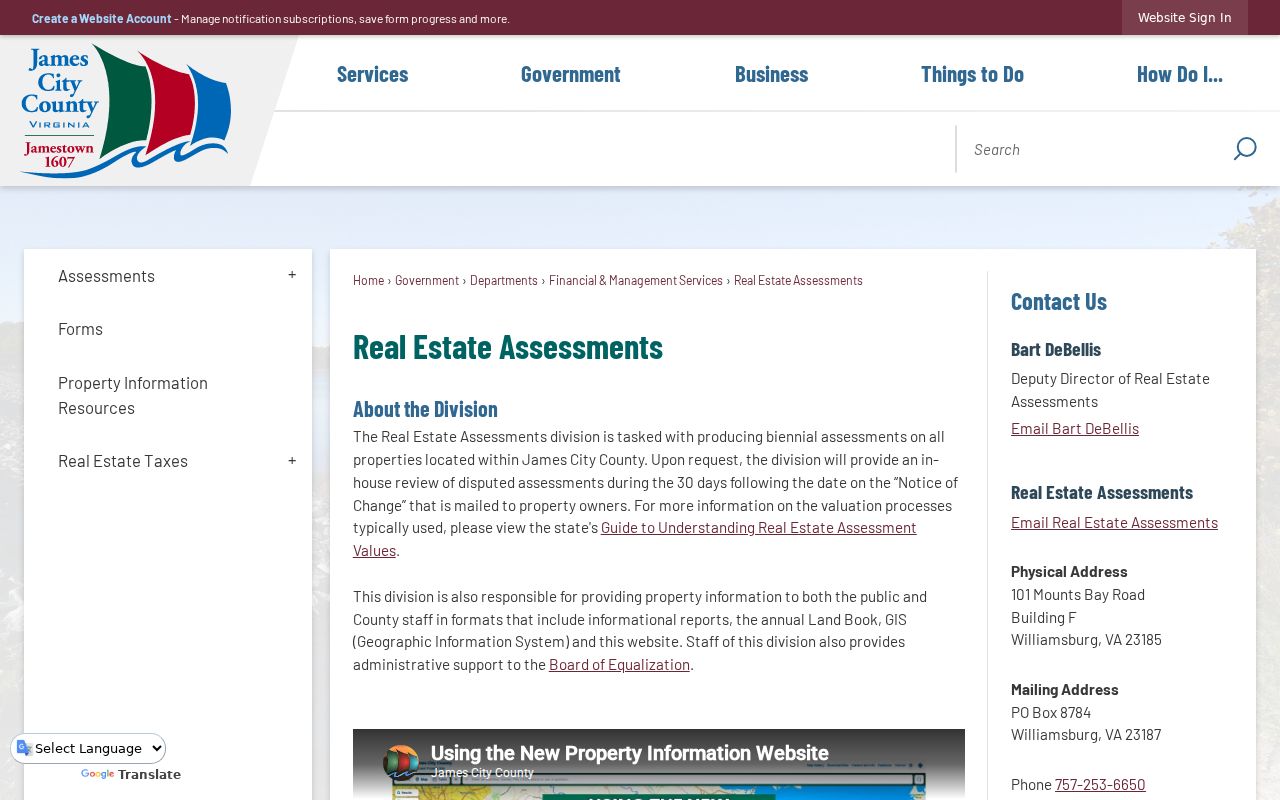
The county's Real Estate Assessments page describes the biennial valuation cycle and the Notice of Change review route.
Note: Confirm the applicable assessment year with the division before comparing the county amount against a recent sale price.
Find Value in James City County Records
Begin with an address, owner name, or parcel ID in the Property Information System. James City County combines assessment and GIS data in the results. Display fields can vary, though. Read each parcel card on its own terms. Use the parcel ID to confirm you have the right lot. Then note the assessment history and any sales price or transfer date shown.
- Search the address, owner name, or parcel ID in the James City County Property Information System.
- Confirm the parcel ID and legal description before reading an assessment number.
- Record the assessment history and any sales price or transfer date shown on the card.
- Use the source-of-title reference to check the recorded deed if the sale figure matters.
- Assessed value
- The county's value for assessment and tax use.
- Market value
- An estimate of likely sale value, usually prepared by an appraiser for a stated purpose.
- Sale price
- The price recorded or reported for one transaction; it is not a current appraisal.
- Reassessment
- The county's biennial assessment update for each property.
Separate Sale Price From Assessment
James City County lists sales prices and transfer dates among the possible fields on a parcel result. A deed supplies the recorded transaction and its legal description, while the assessment system can carry a sales reference and value history. The county publishes no exact sale-price field labels. If the figure matters, read the deed or confirm the source with the Clerk rather than assuming a card entry carries the instrument's full context.
One sale can reflect unique conditions, timing, or terms of its own. It makes a useful comparison point. It cannot establish what the property would fetch today. A tax assessment and the last sale price often disagree because they measure different events through different processes.
Read Land and Building Details
Land and building descriptions can appear alongside assessment history. That happens on a James City County parcel result. Those details show what the county attached to its value: the site, the improvements, and the parcel description. Compare them with the legal description in the deed and the mapped parcel. This matters most when a property changed through construction or a lot adjustment.
The county's May 2026 Property Information release added aerial imagery, parcel downloads, zoning, voting districts, school zones, and direct plat links. These layers add context to the official record, not a private valuation of the building. For a structural question, rely on a qualified appraiser. A market-price opinion also calls for another relevant professional.
No Published County Assessment Ratio
James City County describes its biennial assessments and keeps an assessment history. However, it publishes no separate assessment ratio or level-of-assessment figure. That gap matters. A parcel owner should not assume a ratio. The county does not state a percentage of market value for land. When a ratio matters for a comparison, Real Estate Assessments can explain the method. It also covers the period that applies to the parcel.
Guessing a ratio is a poor shortcut. Dividing an assessed amount by an invented factor does not produce a sale estimate. A tax value supports a bill calculation, nothing more. Market value needs its own evidence and its own purpose.
The county does list land and building descriptions. So the assessment history can hint at what changed. A new improvement shifts a building record. A land adjustment or a corrected legal description can too. None of it proves a market price. For any value comparison, confirm the parcel and the year with Real Estate Assessments. Sales data only carries weight with its recorded context. No county page guarantees that every transaction is comparable or that a past sale amount predicts a current offer.
Use the Tax Rate as Context
James City County's real-estate tax rate is $0.83 per $100 of assessed value. The Board of Supervisors sets the rate each year. That figure belongs to the bill calculation, not to market worth. Rates change. So check the live county page before running an older number through any math.
An illustration helps. An assessed amount of $300,000 at $0.83 per $100 produces $2,490. That total comes before account-specific adjustments or supplemental charges. The county splits the annual bill across June 5 and December 5 due dates. The applicable rate is set each year. Never read value backward out of a payment amount. A tax bill blends the county's assessment with the tax rate and billing rules.
A dispute starts with Real Estate Assessments. The county's published in-house review window runs 30 days after a Notice of Change. Paying the tax bill does not substitute for that review request. For a sale-value opinion, use a qualified appraiser. For the county value itself, confirm the parcel, the year, and the review procedure with the assessment office.
Bill dates, the ePayment route, Notice of Change review, and Board of Equalization support are covered under James City County property tax records. This discussion stops at what the assessment and sale figures mean.
What James City County Assessed Value Is Not
A James City County assessed value is not a promise of sale price. It is not an appraisal for a buyer. It is not a title decision either. The county's biennial roll can lag the latest transaction. No county ratio is published. So the assessment and the deed records can disagree. A GIS layer or a property-card number cannot substitute for a licensed appraisal.
Value versus price. Assessed value supports county taxation. For a current sale-value opinion, use a licensed appraiser and compare the property's full facts and the intended purpose of the appraisal.